How to Read Centimeters on a Measuring Tape
How to read a tape measure easily in metric and imperial measurements
Check out these top tape mensurate tips and tricks for accurate measuring and marker out
Sounds like shooting fish in a barrel just knowing how to read a tape measure in both metric & imperial systems is really handy to know and imperial in particular can be quite tricky in the start.
On acme of explaining that I'll share with y'all some handy tips and cool blueprint features of your record measure out that you may non have know about when you bought it.
Different types of tape measure available and which one do I use depending on the job at hand
There are several different types of measuring tape available each designed for different things;
- Surveyors tape - Contained in a large drum, ofttimes 50m+ long for measuring and setting out large things similar foundations
- Laser distance measure out - often used again by surveyors, I employ mine for quickly measuring walls etc. when estimating carpentry piece of work
- Digital Tape Measure out - A tape mensurate with a digital measurement display, used mainly for apace taking rough measurements when quoting.
- 'Normal' tape measure out - available from 3m to 25m, meaty plenty to keep on your tool belt and the type I use ninety% of the time for carpentry piece of work
Which tape measure is best for Carpentry work on site?
When choosing a tape measure out to buy, look for these things;
- Robust/hard wearing enough to withstand use on site
- Stronger/reinforced at the hook end
- Stiff locking - tape doesn't move when locked
- Articulate markings make it easier to read a record measure out in the rain/nighttime etc. ideally with differentiation in font or color between different types (mm to cm for eg.)
- Clear markings at dissimilar centres such as 400/800/1200mm or 16'/32'/48' as this will save time when marking and setting out
- I like mine to have both imperial and metric measurements and then I can use the type that's easiest to call up or virtually accurate in a given state of affairs
I use this Stanley Fat Max Classic record measure on site
A great all round tape measure out for near people would probably be a 25ft long Lolbiu
Try to keep your record measure equally dry as possible on site. If it does get wet pull the whole thing out and use an one-time towel to dry it before you finish upwardly for the day.
How to take accurate measurements with Imperial and Metric measuring systems when setting out
But use the record measure if you need to
Wherever practical and possible, I prefer to mark timber 'in-situ'. For example, if marking where I demand a mitre on the leg of an architrave effectually a door frame, I prefer to agree information technology upwardly and marking the line exactly where it should be cutting. This helps avoid some margin for error when transferring measurements.
Should the terminate of the tape measure motility & slide dorsum and forth!?
Yes! One thing that ofttimes catches people out when trying to read a tape measure is that the hook on the finish of the tape slides back and forth.
Information technology does this so that the thickness of the hook is accounted for when taking inside and outside measurements.
When you measure in betwixt 2 walls for instance, you lot push the end of the tape in really tight against the wall. Then when hooked onto the end of a slice of timber to transfer that measurement, you pull the tape measure out tight away from that hooked end.
Without this feature the measurement would always exist out by a couple of millimetres or 1/16th of an inch depending on the system y'all read a record measure out with.
Keep the record perfectly level or plumb when measuring
For accuracy when measuring between two points, ensure the tape is tight and doesn't sag in the eye. Go someone to hold i end if this is difficult or blindside a nail in to give y'all something to hook the end of the tape over.
Also, brand sure you hold the tape measure out level or plumb. For instance, if you were getting a measurement between two walls for a Dado Rail that volition be fitted a metre upwardly off the flooring, mark a line up a metre off the floor at each end and hold the tape at that summit.
If ane terminate is high and the other depression, you'll get a longer measurement than you want.
If in incertitude, cut the work-piece a trivial long. You can always cutting more off if need be, its hard to put information technology back on! The more experienced you lot become the amend you'll get at judging when to add/take off a flake from your measurements.
When measuring in between two walls, attempt this tip
The tape measure out itself will often have a measurement on the side which indicates the length of the body itself. This is an corporeality you can add on to the measurement where the tape exits the body and therefore total upward to become the correct overall size from the claw to the outer end of the body.
Even if that size is not credible, you lot can all the same measure the body yourself and know the amount to add together should the situation arise whatsoever fourth dimension.
Or, if the distance is longer;
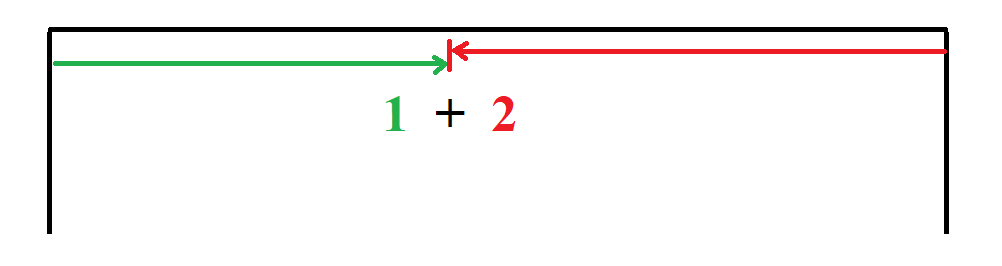
Make two marks for longer measurements
The method in the picture show above helps if you need to read a record mensurate over a particularly long distance, take in betwixt 2 walls for case. First, measure out from i wall out every bit far every bit is hands authentic. Make a marker at a point that is easy to add to another measurement - like 3m for example. Then measure out from the other wall to that mark, and simply add together 3m to the 2nd measurement to get the full length
If in doubt, add together a fiddling on!
Ever add a couple of mm or an 1/8th of an inch if you are unsure, you tin always take it back to the saw and cut more than off!
Difference betwixt Imperial and Metric measurements
At that place are two different numerical measurement systems - Metric and Imperial.
America nonetheless use imperial, then did the UK until around 1995.
At school I was taught to utilize Metric but when I was on my apprenticeship I was taught by an onetime craftsman who still used Regal measurements. The keen matter about this is I tin can & do use both, depending on what is easier in whatever given situation. And I tin adapt and piece of work well with anyone no thing what system they happen to prefer as well.
I generally lean towards Purple but information technology tin become pretty complicated when you are computing Spindle spacings for case where you need to split measurements upwardly.
Metric - Metric measurements are in Millimeters, Centimeters and Meters (and then Kilometres).
At that place are 10 Millimeters in one Centimeter and 100cm (1000mm) in one Metre. When working in Metric you'll mostly use Millimeters as that's most authentic. A canvass of ply in metric is 2400mm x 1200mm (or 2.4m x 1.2m)
Regal - measurements are in Feet and Inches, and fractions of Inches.
One inch is broken upwardly into 16 or fifty-fifty 32 increments, 1 Foot is fabricated up of 12 inches. Imperial measurements are written in Feet and Inches and abbreviated, so half dozen'4 1/iv" means six Feet iv inches and a quarter of an Inch. A sheet of ply in imperial is 8'' x 4'' (96' x 48')
If yous landed on Globe from some other planet and knew neither, metric would probably be the easiest system to learn from scratch!
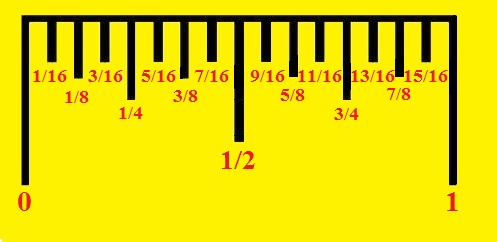
There are 25.4mm in 1". If your tape merely splits Inches into sixteen segments (like in the picture below) then Metric is slightly more than accurate considering ane inch can be broken down into 25.4mm. All the same, some tape measures interruption each inch down into 32 segments, which is so more than accurate than Metric. Choosing the system y'all piece of work with volition probably depend on what your colleagues use and what you find easiest to understand.
How to read tape measure with imperial markings (in Feet, Inches & fractions of inches)
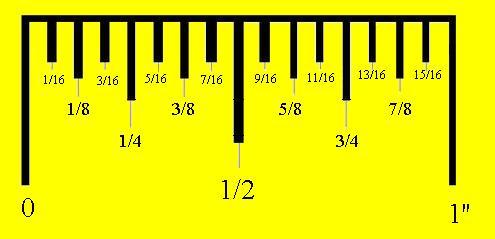
In a higher place is what you'll discover at the starting time of an Royal Tape Measure. Each Inch is broken downwards into sixteen segments. Sixteenths of an inch are accurate enough for most carpenters.
In club to understand and read a tape measure with imperial markings, you will need to have a basic understanding of Fractions.
Although every segment is 1/16th of an Inch, yous don't read the halfway point every bit 8/16ths, because you can 'simplify' that Fraction. If both numbers tin can be divided by another number then that'south what y'all do in society to simplify. Both 8 and 16 can exist divided by 8, so eight/16 is also one/2 Inch (half inch).
Here is each increment of one Inch, simplified;
1/16th
2/16th = one/8th
three/16th
4/16th = 2/8th = one/4
5/16th
6/16th = iii/8th
7/16th
viii/16th = 4/8th = ii/4 = one/two
9/16th
x/16th = v/8th
11/16th
12/16th = 6/8th = iii/4
thirteen/16th
14/16th = 7/eighth
15/16th
xvi/16 = 1 inch
Information technology'due south confusing at first only becomes second nature afterwards a short while.
How to add together 2 imperial measurements or fractions together
It does get a niggling more complicated if you have to add together 2 measurements together. This is fairly directly forward if the bottom numbers of the Fraction are the same,
1/4 + one/four = 2/4 = i/2
And
two/4 + iii/four = 5/4 = 1 and a 1/4
If the bottom numbers are unlike then it takes a niggling more than piece of work and you have to practise the opposite of simplifying the fractions;
ane/16th + 1/eighth
Here, you need to make the numbers nether the lines the same. Change 1/8 dorsum to ii/16 and then all of the sixteenths can be added together and then simplified again afterwards;
one/16th + ii/16 = 3/16th
Another instance;
3/8th + 15/16th
Change 3/8 to half-dozen/xvi (multiply both numbers by two, and then 3 becomes 6 and 8 becomes 16 = vi/16th)
6/xvi + fifteen/16 = 21/16 Or 1 and five/16
I hope that makes sense!
How to read a tape measure out with metric markings, in millimetres, centimetres and metres
Completely dissimilar to an majestic tape measure, information technology is arguably easier to read a tape measure in metric than imperial;
Each small increment is 1mm and there are 10mm that brand upwardly one centimetre.
Each centimetre comprised of 10mm is clearly marked, all the style from one to 100, which becomes 1 metre.
So 1m = 100cm or 1000mm
When adding metric measurements together, if needed you can catechumen them easily to mm in order to exercise so and there are no complicated fractions to worry near;
1.2m + 4.7m = v.9m
1256mm + 4983mm = 6239mm (also 623.9cm or 6.239m)
All that changes is the position of the decimal point!
What are the diamond markings for on a tape measure?
| | |
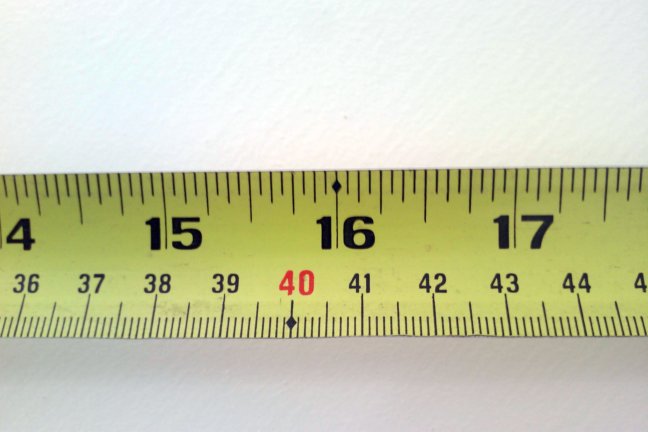
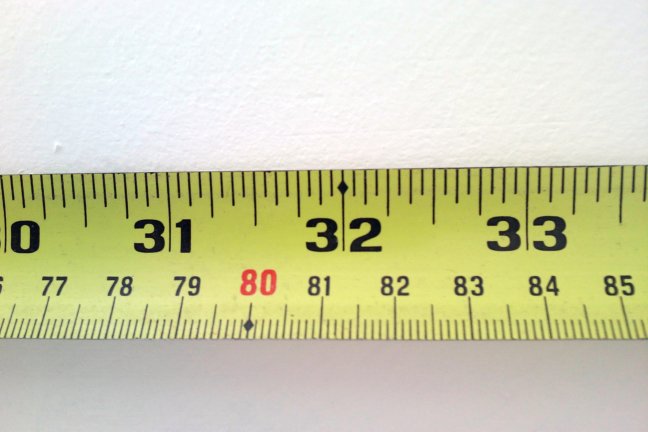
When you lot are building internal walls, setting outwall plates to accept Roof rafters and when Joisting during Carpentry work you need to mark out the center position of each length of timber.
Tape measures are marked so you tin can quickly and easily see where the centers are without having to practice besides much math in your head! Metric centers are 400, 800, 1200mm and so on. Royal centers are xvi, 32, 48 inches and and then on. If yous expect at the pictures above 400mm is red and also has a small black diamond making information technology stand up out from the rest of the measurements. 16 inches isn't ruddy on this particular tape but it does accept a small black diamond, again making it stand out. All you need to do when setting out centers is await for these symbols, making it less likely y'all'll mark any timbers in the wrong positions.
Click here to get to dorsum the main hand tools page
Or click here to cheque the latest prices on tape measures at Amazon
Use the comments box below to add your own tips nigh how to read a tape measure!
Source: https://www.carpentry-tips-and-tricks.com/read-a-tape-measure.html
0 Response to "How to Read Centimeters on a Measuring Tape"
Post a Comment