what has to happen for a nebula to form a star
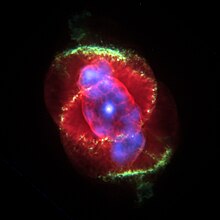
A planetary nebula is a nebula that is fabricated up of gas and plasma. They are fabricated by certain types of stars later in their life. They look like planets through small optical telescopes.[i] They do not last for long compared to a star, only tens of thousands of years.
At the stop of a normal-sized star's life, in the ruby-red giant stage, the exterior layers of a star are ejected. Because the outside is gone, the star shines brightly and is very hot. The ultraviolet radiation given off by the heart of the star ionizes the gas and plasma that was thrown out from the star. This is what causes a planetary nebula to await similar it does.
While some planetary nebulae look similar, others have very distinct and unique shapes. Scientists are non sure why planetary nebulae tin can look then dissimilar from one some other. Scientists remember that binary stars, stellar winds and magnetic fields might exist some of the reasons planetary nebulae can look and so varied.[2] In the early 21st century some astronomers began calling them "globular nebulas" to avert confusing them with the Protoplanetary nebulas that make planets.
Observations [modify | alter source]
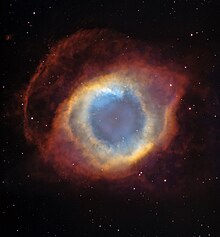
Planetary nebula are not very vivid. None of them are vivid plenty to see without a telescope. The first one discovered was the Dumbbell nebula. Astronomers did non know what these objects were until the get-go spectroscopic experiments were done in the 1800's. William Huggins used a prism to look at galaxies. He noticed that they looked a lot like stars.
When he looked at the Cat's Eye nebula, information technology did not look the same. He saw an emission line at a place that no one had seen earlier. This meant that it looked similar an element that no one had always seen before.[3] Scientists thought it might exist a new chemical element. They decided to telephone call it nebulium.
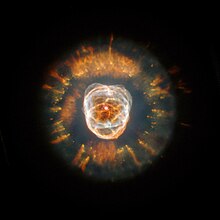
Later on, physicists showed that it is possible for gasses with a very low density to wait like something else.[4] It turned out that the gas they were looking at was oxygen, and not nebulium.
The stars in planetary nebulae are very hot. They are not very bright, though. This means that they must be very small. The but fourth dimension that stars get that pocket-size is when they are dying. That means that they are 1 of the terminal steps in a star's death. Astronomers saw that all planetary nebula are expanding. This meant that they were caused by a star's outer layers being thrown into infinite at the stop of its life.
Origins [change | alter source]
Stars weighing more than eight solar masses volition get supernovae. Stars of lesser mass will form planetary nebulae. Subsequently billions of years of stellar development a star will have no more hydrogen. This makes the surface of the star colder, and makes the core smaller. The sun's core is about 15 one thousand thousand degrees Kelvin. When information technology runs out of hydrogen, the smaller core will crusade it to rise to nearly 100 meg degrees Kelvin.
The outer layers of the star become much bigger considering of the oestrus of the core, and become much cooler. The star becomes a red giant. The core gets even smaller and hotter. When its reaches 100 million K, helium begins to fuse into carbon and oxygen. When this happens, the core stops shrinking. Helium called-for soon forms a core of carbon and oxygen, with both a helium and a hydrogen shell surrounding information technology.
Considering helium in fusion reactions is not very stable, the core starts to abound and shrink very apace. Strong stellar winds blow the gas and plasma in the outer layer of the star outwards. These gases form a cloud effectually the core of the star. Every bit more and more than of the gas moves away from the star, deeper and deeper layers at higher and higher temperatures are sent out. When the gas heats up to around xxx,000 degrees kelvin, the gas starts to glow. The cloud has and then become a planetary nebula.
Numbers and position [alter | change source]
We know of about 3,000 of these nebulae in our milky way, compared to 200 billion stars.[5] Their very brusk lifetime compared to a star is why there are not that many compared to stars. They are institute mostly in the plane of the Galaxy, and there are more and more the closer you get to the center of the Milky Way.[six]
Shape [change | change source]
Only well-nigh twenty percent of planetary nebulae are spheres (similar Abell 39). The residue of them have various shapes. The reason for these shapes is not understood. It may exist because of the gravitational pull of secondary stars (for example, if it is a binary star organisation). A 2d theory is that planets near the star might change how the nebula forms. A third theory is that magnetic fields cause the shapes. [ane] Archived 2008-11-20 at the Wayback Machine.
Problems [change | alter source]
A problem in studying planetary nebulae is that astronomers can not always piece of work out how far away they are. When they are close, astronomers use something called expansion parallax to estimate how far abroad they are, but this takes a long time.[7] If they are non close, there is not yet a good way to observe how distant they are.
[modify | alter source]
- Interstellar medium
- Nebula
- Stellar development
- White dwarf
References [change | change source]
- ↑ Hubble witnesses the last bonfire of celebrity of Sun-like stars Archived 2010-04-01 at the Wayback Car, Hubblesite.org, 1997-12-17. Retrieved 2008-08-09
- ↑ Morris One thousand. 1990. Bipolar asymmetry in the mass outflows of stars in transition. In Mennessier M.O. & Omont, Alain (eds) From Miras to planetary nebulae: which path for stellar evolution? Montpellier, France, September 4–seven, 1989. IAP astrophysics meeting: Atlantica Séguier Frontières, pp. 526–30. ISBN 978-two-86332-077-8
- ↑ Huggins W. & Miller W.A. 1864. On the Spectra of some of the Nebulae. Philosophical Transactions of the Regal Society of London, 154, 437
- ↑ Bowen I.S. 1927. The Origin of the main Nebular Lines. Publications of the Astronomical Order of the Pacific. 39, 295.
- ↑ Parker Q.A. et al. 2006. The Macquarie/AAO/Strasbourg H-alpha Planetary Nebulae Catalogue: Mash, MNRAS 373, 79
- ↑ Majaess D.J; Turner D. & Lane D. 2007. In search of possible associations between planetary nebulae and open clusters, PASP, 119, p1349.
- ↑ Reed D.S et al. 1999. Hubble Space Telescope measurements of the expansion of NGC 6543: Parallax distance and nebular evolution. Astronomical Periodical. 118, 2430.
Other websites [change | change source]
- Entry in the Encyclopedia of Astrobiology, Astronomy, and Spaceflight
- Press release on recent observations of the True cat'due south Eye nebula
- Planetary Nebulae Archived 2005-12-17 at the Wayback Machine, SEDS Messier Pages
- The showtime detection of magnetic fields in the central stars of four planetary nebulae Archived 2008-11-20 at the Wayback Automobile
- Www search for Galactic planetary nebulae Archived 2007-03-eleven at the Wayback Machine
- Planetary nebulae - Data and amateur observations
- Planetary nebula on arxiv.org
Source: https://simple.wikipedia.org/wiki/Planetary_nebula
0 Response to "what has to happen for a nebula to form a star"
Post a Comment