Never Again the Burning Times Quizlet

Book called-for in Berlin, 10 May 1933

Examples of books burned past the Nazis on brandish at Yad Vashem
The Nazi book burnings were a campaign conducted by the German Educatee Union (German: Deutsche Studentenschaft, DSt) to ceremonially burn down books in Nazi Frg and Austria in the 1930s. The books targeted for burning were those viewed equally being subversive or every bit representing ideologies opposed to Nazism. These included books written by Jewish, communist, socialist, anarchist, liberal, pacifist, and sexologist authors among others.[1] The initial books burned were those of Karl Marx and Karl Kautsky,[ii] but came to include very many authors, including Albert Einstein, Helen Keller, writers in French and English, and effectively any book that was not ardent in its support of Nazism. In a campaign of cultural genocide, books were also burned by the Nazis en masse in occupied territories.[3]
Campaign [edit]
Proclamation [edit]
On April eight, 1933, the Main Office for Press and Propaganda of the German Educatee Spousal relationship (DSt) proclaimed a nationwide "Action against the Un-German Spirit", which was to climax in a literary purge or "cleansing" ("Säuberung") by fire. According to historian Karl Dietrich Bracher:
[T]he exclusion of "Left", democratic, and Jewish literature took precedence over everything else. The black-lists ... ranged from Bebel, Bernstein, Preuss, and Rathenau through Einstein, Freud, Brecht, Brod, Döblin, Kaiser, the Isle of mann brothers, Zweig, Plievier, Ossietzky, Remarque, Schnitzler, and Tucholsky, to Barlach, Bergengruen, Broch, Hoffmannsthal, Kästner, Kasack, Kesten, Kraus, Lasker-Schüler, Unruh, Werfel, Zuckmayer, and Hesse. The catalogue went back far enough to include literature from Heine and Marx to Kafka.[iv]
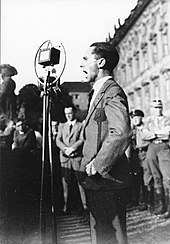
Local chapters were to supply the press with releases and commissioned articles, sponsor well-known Nazis to speak at public gatherings, and negotiate for radio circulate time. The DSt had contacted an official from the Propaganda Ministry to asking back up for their entrada, including having Propaganda Minister Josef Goebbels be the main speaker at the effect in Berlin. Considering Goebbels had studied under several Jewish professors, and had, in the past, praised them despite his avowed antisemitism, he was agape that speaking at the book called-for would cause these by remarks to be dug upwardly by his enemies. As a result, he did not formally accept the invitation to speak – despite his having been listed in the advance publicity – until the last moment.[5]
On the same day, the Student Marriage published the "Twelve Theses", a title chosen to be evocative of two events in German language history: Martin Luther's burning of a papal bull when he posted his ninety-five theses in 1520, and the called-for of a handful of items, including xi books, at the 1817 Wartburg Festival on the 300th ceremony of Luther'southward burning of the bull. This was, however, a false comparison, as the "volume burnings" at those historic events were non acts of censorship, nor destructive of other people's property, but purely symbolic protests, destroying only 1 individual document of each title, for a g total of 12 private documents, without any attempt to suppress their content, whereas the Student Matrimony burned tens of thousands of volumes, all they could find from a list comprising around 4000 titles.[six]
The "Twelve Theses" called for a "pure" national language and culture. Placards publicized the theses, which attacked "Jewish intellectualism", asserted the need to "purify" German linguistic communication and literature, and demanded that universities be centres of German language nationalism. The students described the action as a "response to a worldwide Jewish smear entrada against Germany and an affirmation of traditional German values."
The burnings start [edit]
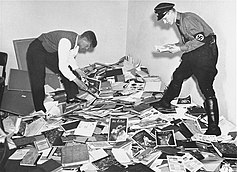
The first large burning came on six May 1933. The German Pupil Union made an organised assault on Magnus Hirschfeld'southward Institut für Sexualwissenschaft (roughly: Institute of Sex activity Research). Its library and archives of around 20,000 books and journals were publicly hauled out and burned in the street. Its collection included unique works on intersexuality, homosexuality, and transgender topics. Dora Richter, the first transgender woman known to take undergone sex reassignment surgery (by doctors at the establish), is causeless to accept been killed during the attack.[7] [8] [9] [10]
On ten May 1933, the students burned upwards of 25,000 volumes of "united nations-German" books in the foursquare at the State Opera, Berlin, thereby presaging an era of uncompromising state censorship. In many other university towns, nationalist students marched in torch lit parades against the "united nations-High german" spirit. The scripted rituals of this nighttime chosen for high Nazi officials, professors, rectors, and pupil leaders to accost the participants and spectators. At the coming together places, students threw the pillaged, banned books into the bonfires with a great joyous ceremony that included live music, singing, "fire oaths," and incantations. In Berlin, some xl,000 people heard Joseph Goebbels deliver a fiery accost: "No to decadence and moral corruption!" Goebbels enjoined the oversupply. "Yes to decency and morality in family and state! I consign to the flames the writings of Heinrich Isle of mann, Ernst Glaeser,[xi] Erich Kästner."
The era of extreme Jewish intellectualism is now at an end. The quantum of the German language revolution has again cleared the fashion on the German path...The future High german man will not just be a homo of books, but a human being of character. It is to this end that we want to educate you. Equally a young person, to already take the courage to face the pitiless glare, to overcome the fear of expiry, and to regain respect for death - this is the task of this young generation. And thus you do well in this midnight hour to commit to the flames the evil spirit of the by. This is a strong, great and symbolic deed - a human action which should document the following for the world to know - Here the intellectual foundation of the November Republic is sinking to the footing, but from this wreckage the phoenix of a new spirit volition triumphantly ascent.
—Joseph Goebbels, Speech to the students in Berlin[12]
In his speech – which was broadcast on the radio – Goebbels' referred to the authors whose books were existence burned as "Intellectual filth" and "Jewish asphalt literati".[5]


Books built into the floor at the museum Story of Berlin
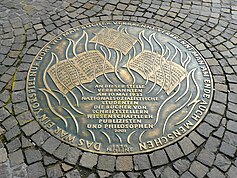


"Lese-Zeichen", ("Book marks"), commemorating the burning of the books on 10 May 1933 at the Bonner Market place
Non all book burnings took place on 10 May as the German language Pupil Union had planned. Some were postponed a few days considering of rain. Others, based on local chapter preference, took place on 21 June, the summertime solstice, a traditional engagement of celebration. Nonetheless, in 34 university towns across Frg the "Action against the Un-German Spirit" was a success, enlisting widespread newspaper coverage. And in some places, notably Berlin, radio broadcasts brought the speeches, songs, and ceremonial incantations "live" to countless German listeners.
All of the following types of literature, as described by the Nazis, were to be banned:
- The works of traitors, emigrants and authors from strange countries who believe they can set on and denigrate the new Deutschland (H. G. Wells, Romain Rolland);
- The literature of Marxism, Communism and Bolshevism;
- Pacifist literature;
- Literature with liberal, democratic tendencies and attitudes, and writings supporting the Weimar Republic (Walther Rathenau,[11] Heinrich Mann, Thomas Mann);[eleven]
- All historical writings whose purpose is to denigrate the origin, the spirit and the culture of the German Volk, or to dissolve the racial and structural order of the Volk, or that denies the force and importance of leading historical figures in favor of egalitarianism and the masses, and which seeks to drag them through the mud (Emil Ludwig);
- Books that advocate "art" which is decadent, bloodless, or purely constructivist (George Grosz, Otto Dix, Bauhaus, Felix Mendelssohn);
- Writings on sexuality and sexual educational activity which serve the egocentric pleasure of the individual and thus, completely destroy the principles of race and Volk (Magnus Hirschfeld[11]);
- The decadent, subversive and Volk-damaging writings of "Cobblestone and Civilisation" literati: (Oskar Maria Graf, Heinrich Mann, Stefan Zweig, Jakob Wassermann, Franz Blei);
- Literature by Jewish authors, regardless of the field;
- Popular entertainment literature that depicts life and life'south goals in a superficial, unrealistic and sickly sugariness manner, based on a bourgeois or upper grade view of life;
- Patriotic kitsch in literature.
- Pornography and explicit literature
- All books degrading German purity.
Many German students were complicit in the Nazi book burning campaign. They were known equally Deutsche Studentenschaft, and when they ran out of books in their ain libraries they turned to independent bookstores. Libraries were asked to stock their shelves with material that stood up to Hitler's standards, and destroy anything that did not.[13]
Cultural genocide in occupied territories [edit]
Among the Nazi crimes against the Polish nation was a campaign of cultural genocide that included the called-for of millions of books, resulting in the destruction of an estimated 80% of all schoolhouse libraries, and three-quarters of all scientific libraries in the country.[3] The Nazis also seized many books from Jewish communities in Eastern Europe. They did intend to proceed and display a few rare and ancient books in a museum on Judaism afterward the Last Solution was successfully completed.[xiv]
[edit]
Amid the other High german-speaking authors whose books student leaders burned were:
Vicki Baum, Walter Benjamin, Ernst Bloch, Franz Boas, Albert Einstein, Friedrich Engels, Etta Federn, Lion Feuchtwanger, Marieluise Fleißer, Leonhard Frank, Sigmund Freud, Iwan Goll, Jaroslav Hašek, Werner Hegemann, Hermann Hesse, Ödön von Horvath, Heinrich Eduard Jacob, Franz Kafka, Georg Kaiser, Alfred Kerr, Egon Kisch, Siegfried Kracauer, Theodor Lessing, Alexander Lernet-Holenia, Karl Liebknecht, Georg Lukács, Rosa Luxemburg, Klaus Mann, Ludwig Marcuse, Karl Marx, Robert Musil, Carl von Ossietzky,[11] Erwin Piscator, Alfred Polgar, Gertrud von Puttkamer, Erich Maria Remarque,[xi] Ludwig Renn, Joachim Ringelnatz, Joseph Roth, Nelly Sachs, Felix Salten,[15] Anna Seghers, Abraham Nahum Stencl, Carl Sternheim, Bertha von Suttner, Ernst Toller, Frank Wedekind, Franz Werfel, Grete Weiskopf, and Arnold Zweig.
Not merely German-speaking authors were burned, but also French authors such as Henri Barbusse, André Gide, Victor Hugo and Romain Rolland; American writers such as John Dos Passos, Theodore Dreiser, F. Scott Fitzgerald, Ernest Hemingway, Helen Keller, Jack London, Upton Sinclair, and Margaret Sanger;[sixteen] as well every bit British authors Joseph Conrad, Radclyffe Hall, Aldous Huxley, D. H. Lawrence, Henry de Vere Stacpoole, H. G. Wells, Irish authors James Joyce and Oscar Wilde; and Russian authors including Isaac Babel, Fyodor Dostoyevsky, Ilya Ehrenburg, Maxim Gorki, Vladimir Lenin, Vladimir Mayakovsky, Vladimir Nabokov, Leo Tolstoy, and Leon Trotsky.
The burning of the books represents a culmination of the persecution of those authors whose oral or written opinions were opposed to Nazi ideology. Many artists, writers and scientists were banned from working and publication. Their works could no longer be found in libraries or in the curricula of schools or universities. Some of them were driven to exile (such as Albert Einstein, Sigmund Freud, Magnus Hirschfeld, Walter Mehring, and Arnold Zweig); others were deprived of their citizenship (for instance, Ernst Toller and Kurt Tucholsky) or forced into a self-imposed exile from society (e.yard. Erich Kästner). For other writers the Nazi persecutions concluded in expiry. Some of them died in concentration camps, due to the consequences of the atmospheric condition of imprisonment, or were executed (like Carl von Ossietzky, Erich Mühsam, Gertrud Kolmar, Jakob van Hoddis, Paul Kornfeld, Arno Nadel, Georg Hermann, Theodor Wolff, Adam Kuckhoff, Friedrich Reck-Malleczewen, and Rudolf Hilferding). Exiled authors despaired and died by suicide, for example: Walter Hasenclever, Ernst Weiss, Carl Einstein, Walter Benjamin, Ernst Toller, and Stefan Zweig.
Responses [edit]
Helen Keller published an "Open Letter to German Students", in which she wrote: "Yous may burn my books and the books of the best minds in Europe, merely the ideas those books contain accept passed through millions of channels and volition proceed."[17]
German Freedom Library [edit]
On ten May 1934, one year afterward the mass book burnings, the German Freedom Library founded by Alfred Kantorowicz was opened to assemble copies of the books that had been destroyed.[18] Because of the shift in political power and the blatant command and censorship demonstrated by the Nazi Party, 1933 saw a "mass exodus of German writers, artists, and intellectuals".[xix] They went into exiled in America, England, and France. On 10 May 1934, those writers in exile in French republic came together and established the Library of the Burned Books where all the works that had been banned, burned, censored, and destroyed were nerveless.[eighteen]
Alfred Kantorowicz, the writer of the 1944 article Library of the Burned Books, was one of the key leaders instrumental in creating this library. In his commodity, he explains start-hand how the library came to be, and how it was finally destroyed. The library not just housed those books banned by the Nazis, the more than important mission was to exist the "center of intellectual anti-Nazi activities".[18] In addition, it had extensive archives "on the history of Nazism and the anti-Nazi fight in all its forms".[18] At the outset of the war, the Nazis were virtually in command in French republic so the French government closed down the library and anyone associated was imprisoned or sent to concentration camps. Once the Nazis occupied Paris, the library and archives were turned over and that was the end of the Library.
In Kantorowicz's words, "the real significance of the Library was not confined to its material existence. When we inaugurated it, we wanted to make that day of shame a mean solar day of glory for literature and for freedom of idea which no tyrant could kill by fire. And furthermore, by this symbolic activeness, we wanted to awaken Europe to the dangers which threatened its spiritual every bit well equally its material beingness."[xviii]
American Library of Nazi Banned Books [edit]
A like library, modeled subsequently one in Paris, was opened at the Brooklyn Jewish Center in Brooklyn, New York on 15 Nov 1934. In that location were speeches given past Rev. Dr. Israel H. Levinthal, Rabbi of the Jewish Center, and the library chairman Rabbi Louis Hammer. An countdown dinner dedicated to Albert Einstein and Heinz Liepmann was held on Dec 22, 1934.[twenty]
The library had as its aim to "gather as many books equally can be secured by authors whose books were burned past the Nazi Authorities at the notable bonfire on 10 May 1933. Also included were general titles relating to "general Jewish interest, in English, Hebrew and Yiddish." Among the authors whose books were available upon the library's opening were Albert Einstein, Maxim Gorki, Helen Keller, Sigmund Freud, Thomas Isle of mann, and many others.[20] Unlike the Paris library, the American library did not take any collection of books relating to Nazi credo, or events or individuals in Nazi Frg.[21]
The library was a stiff advocate for the cause of Zionism, the movement for a Jewish homeland. To the minds of those in charge of the library, the Nazi book burnings represented "proof of [the] urgency" of Zionist affairs.[21] Rabbi Stephen Wise, who spoke at the countdown dinner, had led a protest at Madison Square Garden on the day of the volume called-for, and was an advocate of the Zionist move. Thomas Mann, whose books were part of the library'southward collection, is quoted equally maxim that "what happened in Germany convinced me more than and more than of the value of Zionism for the Jew".[21]
The American Library of Nazi Banned Books remained in place until the Brooklyn Jewish Center closed in the 1970's. Its collection was then donated to the Jewish Theological Seminary of America in New York Urban center.[21]
Allied censorship during de-Nazification [edit]
In 1946, the Centrolineal occupation authorities drew up a listing of over xxx,000 titles, ranging from school books to verse and including works by such authors as von Clausewitz. Millions of copies of these books were confiscated and destroyed. The representative of the Military Directorate admitted that the guild in principle was no dissimilar from the Nazi book burnings.[22]
Artworks were under the same censorship as other media;
all collections of works of art related or dedicated to the perpetuation of German militarism or Nazism will exist closed permanently and taken into custody.
The directives were very broadly interpreted, leading to the devastation of thousands of paintings and thousands more were shipped to deposits in the U.S. Those confiscated paintings still surviving in U.S. custody include, for instance, a painting "depicting a couple of middle aged women talking in a sunlit street in a modest boondocks".[23]
In popular civilization [edit]
- The 1989 film Indiana Jones and the Last Crusade features a scene set to the backdrop of a book burning event, which is function of a large Nazi rally in Berlin attended by Adolf Hitler. The fictional scene was set in 1938 and held at the Institute of Aryan Civilisation.
- Fighting the Fires of Hate: America and the Nazi Volume Burnings is a traveling exhibition produced by the The states Holocaust Memorial Museum. Through historical photographs, documents, and films, it explores how the book burnings became a strong symbol in America's boxing against Nazism and why they continue to resonate with the public—in film, literature, and political soapbox—to this mean solar day.[24] In 2014, the exhibition was displayed in Due west Fargo, North Dakota; Dallas, Texas; and Missoula, Montana.[25]
- In the catastrophe of The Blame from The Astonishing World of Gumball, instead of the parents trying to learn their lessons, they burn the books instead.
See as well [edit]
- Books in Germany
- Degenerate art
- Denazification#Censorship
- Wolfgang Herrmann, the librarian who created the original blacklist of books
- List of authors banned in Nazi Germany
- List of book-burning incidents
References [edit]
Notes
- ^ "Book Burning". United States Holocaust Memorial Museum.
- ^ Strätz, Hans-Wolfgang (1968). Die studentische "Aktion wider den undeutschen Geist" im Frühjahr 1933. In: Vierteljahrshefte für Zeitgeschichte, 16 (in High german). pp. 347–53.
- ^ a b Hench, John B. (2010) Books As Weapons, pg. 31. Ithaca, New York: Cornell University Press. ISBN 978-0-8014-4891-1
- ^ Bracher, Karl Dietrich (1970). The German Dictatorship. Translated past Jean Steinberg. New York: Penguin Books. p. 325. ISBN0-xiv-013724-6.
- ^ a b Reuth, Ralf Georg (1993). Goebbels. A Harvest Book. Translated by Winston, Krishna. Harcourt Caryatid. pp. 182–183. ISBN9780156001397 . Retrieved 28 July 2021.
- ^ "When Books Burn: A University of Arizona Special Collections Exhibit". ualibr-exhibits.s3-website-us-w-2.amazonaws.com . Retrieved 2021-10-01 .
- ^ "Institute of Sexology". Qualia Folk. 8 Dec 2011. Archived from the original on eighteen Jan 2015. Retrieved 18 January 2015.
- ^ John Lauritsen; David Thorstad (1974), The Early Homosexual Rights Move (1864–1935) , New York: Times Change Press, pp. 40–41, ISBN0-87810-027-10 . Revised edition published 1995, ISBN 0-87810-041-5.
- ^ Evans, Richard J. (2004). The coming of the 3rd Reich (1st American ed.). New York: Penguin Printing. ISBN1-59420-004-1. OCLC 53186626.
- ^ "Dorchen's Twenty-four hour period – Providentia". drvitelli.typepad.com. December 5, 2010. Retrieved February three, 2016.
- ^ a b c d e f Frei, Norbert (1993) National Socialist Rule in Frg: The Führer Country 1933-1945. Translated past Simon B. Steyne. Oxford, Blackwell Publishers. p.62 ISBN 0-631-18507-0
- ^ Dickerman, Michael; Bartrop, P.R. (2017). The Holocaust: An Encyclopedia and Certificate Collection [iv Volumes]. ABC-CLIO. p. 458. ISBN9781440840845.
- ^ Battles, M (2003). "Knowledge On Fire". American Scholar. three (35).
- ^ Lyons, Martyn. Books: A Living History. Los Angeles: J. Paul Getty Museum, 2011. chapter v p.200-1
- ^ Schulz, Kathryn (Jan 17, 2022) "'Bambi' Is Even Bleaker Than You Idea" The New Yorker
- ^ Staff (Winter 2002/2003) "The Sanger-Hitler Equation" New York University: The Margaret Sanger Papers Projection, Newsletter #32
- ^ Baez 2011, p. 211
- ^ a b c d e Kantorowicz, A. (1944). Library of the Burned Books. The New Republic, 110(20), 686-688.
- ^ Noble, L. (2019). "Called-for Books". Cambridge University Library . Retrieved November 3, 2019.
- ^ a b "Nazi Banned Books - Articles | Brooklyn Jewish Eye Circle - Connecting to our By - Preserving our Hereafter". www.brooklynjewishcenter.org . Retrieved 2020-11-twenty .
- ^ a b c d von Merveldt, Nikola (Wintertime 2007). "Books Cannot Be Killed by Fire: The German Freedom Library and the American Library of Nazi-Banned Books as Agents of Cultural Retentiveness". Library Trends. 55 (3): 523–535. doi:10.1353/lib.2007.0026. hdl:2142/3723. S2CID 39301623 – via EBSCO.
- ^ "Read No Evil". Time. May 27, 1946. Archived from the original on 2009-06-27.
- ^ Goldstein, Cora. "PURGES, EXCLUSIONS, AND LIMITS: ART POLICIES IN GERMANY 1933-1949". Archived from the original on December 23, 2007.
- ^ "Fighting the Fires of Detest: America and the Nazi Book Burnings". United States Holocaust Memorial Museum.
- ^ "Electric current Schedule: Fighting the Fires of Hate". Us Holocaust Memorial Museum. Retrieved August thirteen, 2014.
Bibliography
- Mauthner, Martin (2007) German language Writers in French Exile, 1933-1940, London: Vallentine Mitchell. ISBN 978-0-85303-540-4
- This commodity incorporates text from the United states of america Holocaust Memorial Museum, and has been released nether the GFDL.
External links [edit]
- United States Holocaust Memorial Museum - Holocaust Encyclopedia: Book Burning
- United States Holocaust Memorial Museum - Library Bibliography: 1933 Book Burnings
- Jewish Virtual Library - The Burning of the Books
- "Fighting the Fires of Hate: America and the Nazi Book Burnings". Traveling exhibition produced by the United states of america Holocaust Memorial Museum.
- Verbrannte Orte-Scorched Places, map of places in gimmicky Deutschland
Source: https://en.wikipedia.org/wiki/Nazi_book_burnings
0 Response to "Never Again the Burning Times Quizlet"
Post a Comment